

Financial crime has become one of the most serious threats to the global financial system. Criminal organizations often attempt to disguise the origin of illegal funds through complex financial transactions, a process known as money laundering. Because of this risk, financial institutions and regulated businesses must implement strong anti-money laundering (AML) controls to detect and prevent suspicious activity.
One of the most important elements of an effective AML compliance framework is AML risk assessment. Without a proper risk assessment process, organizations may struggle to identify vulnerabilities in their systems or understand where financial crime risks may arise.
An AML risk assessment helps institutions identify, evaluate, and manage the risks associated with money laundering and terrorist financing. It enables organizations to apply a risk-based approach, meaning they allocate resources and monitoring efforts based on the level of risk involved.
This guide explains everything you need to know about AML risk assessment, including what it is, why it is required, how to perform it, common risk factors, and practical examples. By the end of this article, you will have a clear understanding of how AML risk assessments support compliance programs and help organizations manage financial crime risks effectively.
Table of Contents
Use Coupon Code:
Use this coupon at Checkout
What Is an AML Risk Assessment?
AML Risk Assessment Definition
An AML risk assessment is a structured process used by organizations to identify and evaluate the potential risks of money laundering and terrorist financing within their operations.
The process involves analyzing different aspects of a business, such as customers, products, services, transactions, and geographic exposure. By examining these factors, organizations can determine where financial crime risks are most likely to occur.
The purpose of the assessment is not only to identify risk but also to measure how effectively existing controls reduce that risk.
Purpose of an AML Risk Assessment
The primary purpose of an AML risk assessment is to help organizations understand their exposure to financial crime risks. Once risks are identified, companies can implement appropriate controls to mitigate them.
Some key objectives of AML risk assessments include:
- Identifying potential money laundering risks
- Supporting AML compliance programs
- Improving monitoring and reporting systems
- Allocating compliance resources effectively
- Supporting regulatory compliance requirements
By understanding risk exposure, institutions can prioritize high-risk areas and improve the effectiveness of their financial crime prevention strategies.
AML Risk Assessment Definition
AML risk assessment plays a critical role in financial crime prevention. It forms the foundation of an organization’s AML compliance framework.
Without a proper risk assessment, institutions may fail to detect suspicious activity or allocate resources efficiently.
Some important benefits include:
- Helping organizations detect vulnerabilities in their systems
- Supporting regulatory compliance expectations
- Improving monitoring of high-risk customers or transactions
- Protecting an organization’s reputation
- Strengthening internal compliance processes
Financial regulators also expect organizations to maintain updated risk assessments as part of their compliance obligations.
Why AML Risk Assessments Are Required
Regulatory Expectations
Regulators across the world require financial institutions to maintain strong AML compliance programs. A core element of these programs is the ability to identify and manage risks related to financial crime.
The concept of a risk-based approach is widely used in AML frameworks. This approach allows organizations to focus more attention on areas with higher risk while applying proportionate controls to lower-risk areas.
AML risk assessments help institutions demonstrate that they understand their exposure to financial crime risks and have appropriate controls in place.
Consequences of Poor AML Risk Assessment
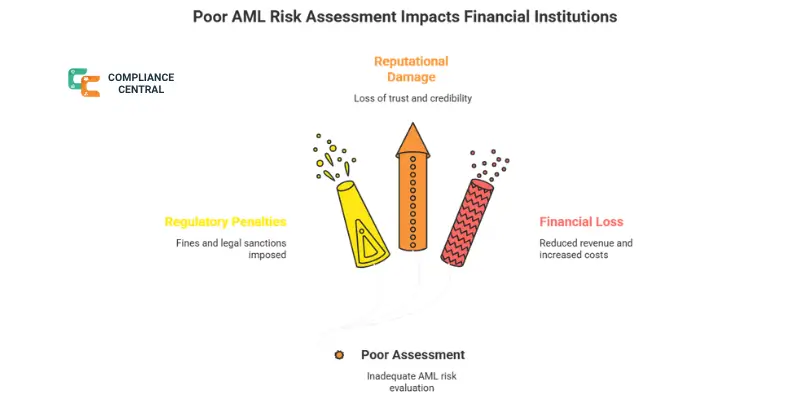
Failing to conduct a proper AML risk assessment can lead to serious consequences.
Organizations that do not adequately assess their risks may experience:
- Regulatory penalties
- Operational disruptions
- Reputational damage
- Increased exposure to financial crime
Weak risk assessment processes may also lead to ineffective monitoring systems, making it difficult to identify suspicious transactions.
Organizations That Require AML Risk Assessments
Many different types of organizations are required to conduct AML risk assessments.
These may include:
- Banks and financial institutions
- Payment service providers
- Fintech companies
- Insurance companies
- Money service businesses
- Investment firms
Each organization must evaluate its own risk exposure based on its customers, services, and geographic reach.
Key Risk Factors in an AML Risk Assessment
AML risk assessments typically evaluate several core risk factors. These factors help organizations understand where money laundering risks may arise.
Customer Risk
Customer risk is one of the most significant factors in AML risk assessments. Certain types of customers may present a higher risk of financial crime.
Examples of high-risk customer characteristics may include:
- Complex ownership structures
- Politically exposed individuals
- Customers operating in high-risk industries
- Customers conducting unusually large or frequent transactions
Organizations must assess customer risk levels during onboarding and throughout the business relationship.
Product and Service Risk
Certain financial products and services may create opportunities for money laundering if they are not properly monitored.
Products that allow rapid movement of funds or anonymous transactions may carry higher risks. Institutions must evaluate how their services may be used and implement appropriate monitoring controls.
Geographic Risk
Geographic risk refers to the exposure an organization has to high-risk countries or jurisdictions.
Some jurisdictions may have weaker financial regulations or limited oversight, increasing the potential for financial crime.
Organizations operating across multiple regions must carefully assess the risk associated with each location.
Geographic Risk
Delivery channels refer to the methods through which financial services are provided.
Examples include:
- Online platforms
- Mobile banking
- Third-party intermediaries
Some delivery channels may make it harder to verify customer identities or monitor transactions effectively.
Types of Risk in AML
Understanding different types of risk helps organizations structure their AML risk assessment process more effectively.
Customer Risk
Customer risk relates to the characteristics and behavior of clients. High-risk customers may require enhanced monitoring.
Geographic Risk
Geographic risk focuses on exposure to jurisdictions with higher levels of financial crime risk.
Product or Service Risk
Some products or services may be more vulnerable to misuse by criminals.
Transaction Risk
Transaction risk relates to the movement of funds, including unusual transaction patterns or large transfers that may indicate suspicious activity.
How to Perform an AML Risk Assessment
Conducting an AML risk assessment typically involves several structured steps. Each step helps organizations identify, measure, and manage financial crime risks.
Step 1 – Identify Risk Factors
The first step is identifying the potential sources of risk.
Organizations should evaluate:
- Customer types
- Products and services
- Geographic exposure
- Transaction patterns
Identifying these factors provides the foundation for the entire risk assessment process.
Step 2 – Collect Relevant Data
Once risks are identified, organizations must gather relevant data to analyze those risks.
This data may include:
- Customer profiles
- Transaction records
- Internal compliance reports
- Operational information
Data collection helps provide evidence for evaluating risk levels.
Step 3 – Evaluate Inherent Risk
Inherent risk represents the level of risk present before any controls are applied.
For example, a company offering international financial services may naturally face higher inherent risks than a local business.
Understanding inherent risk helps institutions evaluate the level of exposure they face.
Step 4 – Assess Control Effectiveness
Organizations must evaluate the effectiveness of their existing controls.
Examples of controls include:

- customer verification procedures
- transaction monitoring systems
- internal compliance policies
Strong controls reduce the likelihood that financial crime will occur.
Step 5 – Apply Risk Scoring
Many organizations use risk scoring models to measure risk levels.
Risk scoring allows institutions to classify risks into categories such as:
- low risk
- medium risk
- high risk
This approach helps compliance teams prioritize monitoring activities.
Step 6 – Determine Residual Risk
Residual risk refers to the level of risk remaining after controls have been applied.
Even with strong controls, some level of risk may still remain.
Understanding residual risk helps organizations determine whether additional measures are required.
Step 7 – Document and Review the Assessment
The final step involves documenting the entire risk assessment process.
Documentation is essential for:
- internal governance
- regulatory review
- future updates
Organizations should also review and update their risk assessments regularly to ensure they remain accurate.
AML Risk Assessment Requirements
Regulatory Expectations
Regulators expect organizations to maintain documented AML risk assessments that reflect their business activities and risk exposure.
Risk assessments should demonstrate that institutions understand their risks and have appropriate controls in place.
Product and Service Risk
Certain financial products and services may create opportunities for money laundering if they are not properly monitored.
Products that allow rapid movement of funds or anonymous transactions may carry higher risks. Institutions must evaluate how their services may be used and implement appropriate monitoring controls.
Internal Policy Requirements
Organizations should integrate risk assessments into their internal policies and compliance programs.
Risk assessment results often influence decisions such as:
- monitoring priorities
- internal controls
- resource allocation
Documentation and Reporting
Clear documentation is essential for transparency and accountability.
Organizations must maintain records of their risk assessment methodology, findings, and review processes.
AML Risk Assessment Example
Understanding examples can help clarify how AML risk assessments work in practice.
Business-Wide AML Risk Assessment Example
A financial institution may conduct a business-wide risk assessment that evaluates all areas of its operations.
The assessment may consider:
- customer demographics
- transaction volume
- geographic exposure
- delivery channels
This type of assessment provides an overall view of risk across the organization.
Customer Risk Assessment Example
Customer risk assessments focus specifically on evaluating the risk associated with individual clients.
Organizations may analyze:
- identity verification information
- transaction volume
- transaction patterns
- industry sector
This helps determine whether enhanced monitoring is required.
Transaction Risk Assessment Example
Transaction risk assessments analyze financial activity to identify patterns that may indicate suspicious behavior.
Organizations may monitor factors such as:
- unusually large transactions
- rapid movement of funds
- transactions involving high-risk jurisdictions
AML Risk Assessment Methodologies
Different methodologies can be used to conduct AML risk assessments.
Qualitative Risk Assessment
Qualitative risk assessments rely on expert judgment and descriptive analysis rather than numerical scoring.
This approach may involve categorizing risks based on experience and professional knowledge.
Quantitative Risk Assessment
Quantitative methods use numerical data and scoring models to evaluate risk.
This approach may involve statistical analysis or risk scoring systems.
Hybrid Risk Assessment Model
Many organizations use a hybrid approach that combines both qualitative and quantitative methods.
This approach allows institutions to balance structured analysis with professional judgment.
Documentation and Reporting
Clear documentation is essential for transparency and accountability.
Organizations must maintain records of their risk assessment methodology, findings, and review processes.
Common Challenges in AML Risk Assessment
Organizations may encounter several challenges when conducting AML risk assessments.
Outdated Risk Models
Risk environments change over time. Outdated models may fail to reflect current risks.
Poor Documentation
Incomplete documentation can make it difficult to demonstrate compliance during regulatory reviews.
Weak Data Analysis
Risk assessments rely heavily on accurate data. Weak data analysis may lead to incorrect conclusions.
Lack of Continuous Monitoring
Risk assessments should not be static. Continuous monitoring helps organizations detect emerging risks.
Best Practices for Effective AML Risk Assessment
Organizations can improve their risk assessment processes by following certain best practices
Regular Risk Review
Risk assessments should be reviewed regularly to ensure they reflect current business activities.
Strong Internal Controls

Effective internal controls help reduce financial crime risks.
Integration With Compliance Programs
Risk assessments should be integrated into broader compliance programs.
Using Technology for Risk Monitoring
Technology can support risk assessment processes by analyzing large volumes of data and identifying unusual patterns.
Conclusion
AML risk assessment is a critical component of any effective anti-money laundering framework. It enables organizations to identify potential vulnerabilities and understand where financial crime risks may arise.
By evaluating customer types, geographic exposure, products, and transactions, institutions can gain a clear picture of their risk environment. This allows them to apply a risk-based approach and allocate resources more effectively.
A well-structured AML risk assessment also supports regulatory compliance and strengthens an organization’s overall financial crime prevention strategy.
As financial systems continue to evolve, organizations must regularly review and update their risk assessments to address emerging risks and maintain effective compliance programs.
If you want to improve your understanding of AML compliance frameworks and risk assessment processes, an Anti Money Laundering Training course can provide structured learning on financial crime prevention and AML risk concepts used across the financial sector.
Frequently Asked Questions (FAQ)
AML checks are processes to verify identity, monitor transactions, and assess financial risk to prevent money laundering.
They protect businesses from legal penalties, prevent financial crime, and maintain transparency in the financial system.
Types include Customer Due Diligence (CDD), Enhanced Due Diligence (EDD), transaction monitoring, PEP screening, and sanctions checks.
Duration varies depending on complexity, risk level, and the sector, ranging from a few hours to several days for high-risk clients.
CDD is the standard verification process, while EDD involves deeper investigation for high-risk clients.
Potential consequences include account suspension, legal penalties, fines, or denial of financial services.

Related Blogs




Course Categories
- Workplace Safety
- Travel
- Training
- Therapy
- Technology
- Teaching and Education
- Teaching and Academics
- Teaching
- Stress Management
- Sports
- Safeguarding
- QLS Endorsed
- Public Speaking
- Psychology
- Project Management
- Philosophy
- Personal Development
- Nutrition & Diet
- Mental Health
- Marketing
- Management
- Lifestyle
- Leadership
- Law
- Language
- IT and Software
- Interpersonal Communication
- Hospitality
- Healthcare
- Health and Social Care
- Health and Safety
- Health and Fitness
- Hazard Awareness
- Forensic Science
- Food Safety
- Food Hygiene
- Food & Beverage
- First Aid
- Fire Safety
- Fashion Design
- Fashion
- Environment
- Entrepreneurship
- Engineering
- Employability
- Electronics
- Electrical Safety
- Education
- Development
- Design
- Data Science
- Counselling
- Cooking
- Construction
- Communication
- Cleaning
- Child Psychology
- Child Care
- Business Skills
- Business Skill
- Business
- Awareness
- Assertiveness
- Animal Care
- Agriculture
- Accounting and Finance