

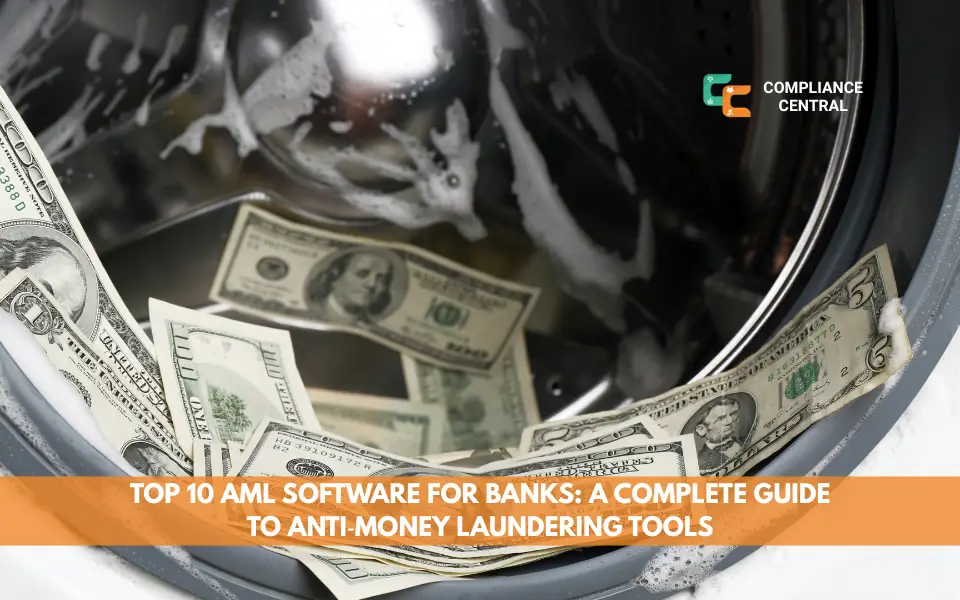
In today’s financial world, banks face constant pressure to prevent financial crime, maintain regulatory compliance, and protect their customers from fraud and illicit activity. Among the most persistent threats is money laundering — the process by which criminals disguise the origin of illegally obtained funds and integrate them into the legitimate financial system. The consequences of inadequate controls can be severe: regulatory fines, reputational damage, operational risk, and even criminal liability.
To address these challenges, banks around the world rely on Anti‑Money Laundering (AML) software — specialised systems that automate and enhance compliance processes. These powerful tools help banks monitor transactions, verify customer identities, screen for risk, detect suspicious patterns, and report potential violations to regulators.
This blog explores the top 10 AML software solutions for banks, explains what AML software is, describes key features banks should look for, and highlights future trends in AML technology. Whether your bank is upgrading its compliance stack or evaluating AML solutions for the first time, this guide will help you make informed decisions.
Table of Contents
Anti Money Laundering Training Course for just £11.99 Today!
You won’t find this deal anywhere else!
Take The CourseUse Coupon Code:
Use this coupon at Checkout
Top 10 AML Software for Banks
Below are the leading AML platforms currently used by banks and financial institutions. These solutions are ranked based on industry adoption, AML capabilities, technological innovation, and ability to support regulated institutions.
1. ComplyAdvantage
Overview:
ComplyAdvantage uses artificial intelligence and machine learning to help banks identify and assess AML risk in real time. Its AML software focuses on dynamic sanctions screening, transaction monitoring, and risk intelligence.
Key Features:
- Real‑time monitoring for suspicious activity
- Global sanctions and watchlist screening
- AML risk scoring for customers
- Comprehensive case management
- Large coverage of high‑risk data sources
Why Banks Use It:
ComplyAdvantage’s strength lies in its use of AI to detect patterns that rule‑based systems might miss. It also updates risk signals quickly, enabling financial institutions to respond to emerging threats.
2. NICE Actimize
Overview:
NICE Actimize offers a comprehensive suite for financial crime compliance, including AML, fraud detection, and trading surveillance. It is widely adopted by large global banks.
Key Features:
- Advanced analytics and machine learning
- Enterprise‑wide AML case management
- Scenario‑based alert generation
- Integration with core banking systems
Why Banks Use It:
NICE Actimize excels at combining AML with broader financial crime detection capabilities, making it ideal for large institutions with complex operations.
3. SAS Anti‑Money Laundering
Overview:
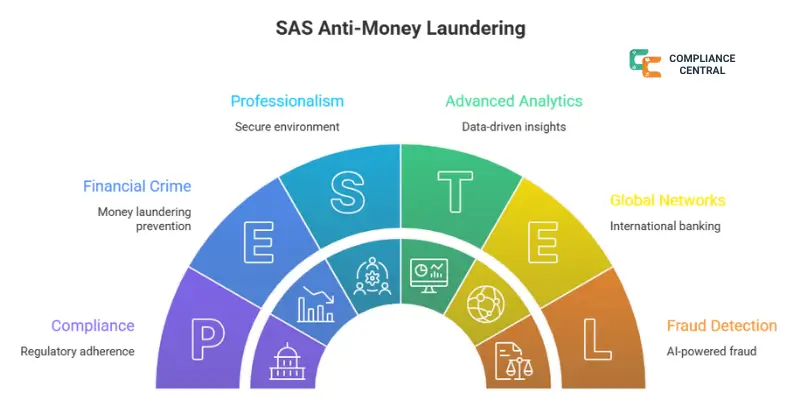
SAS Institute provides a robust analytics‑driven AML solution that helps banks detect unusual behaviour and patterns indicative of money laundering.
Key Features:
- Predictive analytics and AI
- Network analysis to uncover hidden links
- Anomaly detection across transactions
- Scalable detection engines
Why Banks Use It:
SAS AML is known for its deep analytical capabilities, enabling banks to identify complex laundering schemes that may evade simpler systems.
4. Oracle Financial Services AML
Overview:
Oracle Financial Services AML solution is tailored for large financial institutions requiring scalable, highly configurable compliance tools.
Key Features:
- Comprehensive transaction monitoring
- Case management and reporting workflows
- Risk profiling and scoring
- Integration with other Oracle banking products
Why Banks Use It:
Oracle’s AML software integrates seamlessly with other enterprise systems, offering strong reporting and enterprise‑grade performance.
5. LexisNexis Risk Solutions
Overview:
LexisNexis Risk Solutions offers AML software that combines watchlist screening, identity verification, and compliance risk intelligence.
Key Features:
- Extensive global watchlist and sanctions data
- Identity verification and device analytics
- Ongoing AML compliance updates
- Alerts and case triaging
Why Banks Use It:
LexisNexis is valued for its vast compliance data sources and is widely used for AML screening and identity risk assessment.
6. Napier AI
Overview:
LexisNexis Risk Solutions offers AML software that combines watchlist screening, identity verification, and compliance risk intelligence.
Key Features:
- AI‑powered transaction monitoring
- Risk scoring & heat maps
- Graph analytics for link detection
- Fully auditable case management
Why Banks Use It:
Napier’s use of graph analysis helps banks uncover hidden relationships between customers and transactions.
7. Fenergo
Overview:
Fenergo focuses on client lifecycle management with integrated AML checks, making it ideal for banks needing compliance throughout onboarding and ongoing KYC.
Key Features:
- KYC and AML integration
- Client onboarding automation
- Data harmonisation across systems
- Regulatory reporting support
Why Banks Use It:
Fenergo helps banks reduce onboarding risk and ensures AML compliance is embedded throughout the customer lifecycle.
8. Quantexa
Overview:
Quantexa uses contextual decision intelligence to connect fragmented data and provide deep insights into risk relationships across customers and transactions.
Key Features:
- Entity resolution and network analytics
- Intelligent risk scoring
- Powerful link analysis for hidden networks
- Multi‑data source consolidation
Why Banks Use It:
Quantexa excels at detecting organised crime networks by analysing long‑distance relationships that traditional AML systems might miss.
9. Verafin
Overview:
Verafin is a popular cloud‑based AML and fraud detection solution used by many banks and credit unions.
Key Features:
- Cloud deployment for scalability
- In‑depth transaction monitoring
- Collaboration within and across institutions
- Efficient case tracking and workflow
Why Banks Use It:
Verafin’s cloud approach means lower infrastructure costs and easier deployment, making it attractive to mid‑sized banks.
10. Dow Jones Risk & Compliance
Overview:
Dow Jones Risk & Compliance provides AML tools that focus on sanctions screening, PEP monitoring, and global risk intelligence.
Key Features:
- Comprehensive watchlist and sanctions data
- Politically Exposed Persons (PEP) lists
- Enhanced risk scoring
- Integration with AML case systems
Why Banks Use It:
Dow Jones is valued for its global data depth and regulatory coverage, essential for cross‑border AML compliance.
What Is AML Software?
Definition of AML Software
AML software is a type of compliance tool designed to help banks and financial institutions detect, prevent, and report money laundering activities. It automates key AML processes that would otherwise require significant manual effort, enabling faster risk detection and more accurate regulatory reporting.
In practice, AML software assists banks with:
- Transaction monitoring: Identifying unusual patterns in account activity.
- KYC and identity verification: Ensuring the legitimacy of customers.
- Watchlist and sanctions screening: Cross‑checking customers against global databases.
- PEP detection: Flagging politically exposed persons who present higher risk.
- Case management: Providing tools to investigate and report suspicious activity.
Definition of AML Software
Transaction Monitoring
Monitors transactional activity in real time or near real time to identify patterns associated with money laundering, such as rapid movement of funds or unusually large transactions.
Customer Risk Profiling
AML tools assign risk scores based on customer data, transaction history, and known high‑risk factors like involvement in specific industries or geographies.
Sanctions and Watchlist Screening
Integrates global sanctions databases and law enforcement watchlists to prevent onboarding or transacting with sanctioned individuals or entities.
Suspicious Activity Reporting
Facilitates the creation and submission of Suspicious Activity Reports (SARs) to regulatory authorities when a risk threshold is exceeded.
Politically Exposed Persons (PEP) Detection
Flags customers who are politically exposed, requiring enhanced due diligence due to corruption risk.
Why Banks Need AML Software
Banks face a complex risk landscape. AML software isn’t optional — it is a mandatory tool for compliance and risk management.
Regulatory Compliance
Financial regulators across jurisdictions require banks to implement AML measures that align with global standards set by bodies such as the Financial Action Task Force (FATF). Failure to comply can result in:

- Large regulatory fines
- Legal sanctions
- Restricted banking privileges
Prevent Financial Crime
AML solutions help banks identify potential money laundering, terrorist financing, fraud, and embezzlement — protecting both the institution and its customers.
Reduce Manual Workload
Manual AML processes are slow, error‑prone, and expensive. Automation through AML software enables compliance teams to focus on high‑risk alerts instead of routine verification tasks.
Improve Risk Management
By integrating data and deploying risk analytics, banks can prioritise high‑risk customers and transactions before they cause compliance issues.
Key Features to Look for in AML Software
When evaluating AML solutions, banks should look for several core features that define the effectiveness of a platform.
Transaction Monitoring
Real‑time tracking of financial activities to detect suspicious behaviours such as:
- Rapid fund transfers
- Multiple international movements
- Unusually large cash activity
Sanctions & Watchlist Screening
A robust sanctions screening module ensures compliance with global restrictions and prevents high‑risk individuals from accessing services.
PEP Screening
Detecting politically exposed persons enables banks to apply enhanced due diligence where needed.
AI and Machine Learning Capabilities
Modern AML software uses machine learning to detect patterns traditional rule‑based systems can miss, reducing false positives and improving detection accuracy.
Reporting and Case Management Tools
Effective AML solutions provide clear dashboards, audit trails, and tools to escalate and document suspicious activity.
How Banks Choose the Best AML Software
Selecting the right AML platform involves careful evaluation.
Regulatory Requirements
Banks must comply with local and international AML regulations. Choose software aligned with standards like those set by FATF and domestic regulators.
Scalability and Integration
A good AML system should integrate with existing banking platforms and scale as the organisation grows.
Cost and Implementation
Consider total cost of ownership — licensing, deployment, maintenance, and training expenses.
Vendor Reputation and Support
Choose vendors known for performance, strong customer service, and frequent updates as regulations evolve.
Future Trends in AML Technology
The world of AML tools is rapidly evolving with technology.
AI‑Driven AML Detection
AI and machine learning will continue to enhance pattern detection capabilities — especially for complex schemes.
Cloud‑Based AML Platforms
Cloud deployment offers lower infrastructure costs and easier updates — making AML more accessible to smaller institutions.
Real‑Time Monitoring
As payment systems accelerate, real‑time context and monitoring are becoming essential.
Conclusion
Money laundering continues to pose a major threat to global financial systems. To protect against fraud, terrorist financing, and criminal conduct, banks must adopt powerful, reliable Anti‑Money Laundering software.
The top 10 AML platforms highlighted here — including ComplyAdvantage, NICE Actimize, SAS AML, Oracle, LexisNexis Risk Solutions, Napier AI, Fenergo, Quantexa, Verafin, and Dow Jones Risk & Compliance — represent some of the most advanced solutions available today. Each brings unique strengths, from AI‑driven analytics to comprehensive compliance suites.
Choosing the right AML solution is critical for maintaining regulatory compliance, detecting suspicious transactions, and improving risk management. It also helps financial institutions stay ahead of criminal tactics and adapt to evolving regulatory expectations.
For professionals and compliance teams looking to deepen their understanding of AML frameworks, regulations, and technology, structured training such as Anti Money Laundering Training offers comprehensive guidance. These programs help individuals better understand software capabilities, reporting requirements, and compliance best practices — supporting stronger AML defenses and reduced operational risk.
By integrating the right AML software and continuously improving your compliance strategy, banks can build safer, more transparent financial ecosystems and protect themselves and their customers from financial crime.
Frequently Asked Questions (FAQ)
Banks commonly use platforms like ComplyAdvantage, NICE Actimize, SAS AML, Oracle AML, and LexisNexis Risk Solutions to monitor transactions and manage compliance.
The “most effective” solution depends on bank size, risk profile, and specific needs, but tools with AI‑driven monitoring, sanctions screening, and risk analytics are highly regarded.
AML software automates tasks such as transaction monitoring, sanctions screening, identity verification, and suspicious activity reporting to help banks comply with anti‑money laundering laws.
- OFAC (Office of Foreign Assets Control) administers and enforces economic and trade sanctions in the USA.
- FATF (Financial Action Task Force) sets global AML/CFT (counter‑terrorist financing) standards that member countries implement in law.
Yes. Most financial regulators mandate AML compliance, and software is a primary way to meet monitoring and reporting requirements.

Related Blogs




Course Categories
- Workplace Safety
- Travel
- Training
- Therapy
- Technology
- Teaching and Education
- Teaching and Academics
- Teaching
- Stress Management
- Sports
- Safeguarding
- QLS Endorsed
- Public Speaking
- Psychology
- Project Management
- Philosophy
- Personal Development
- Nutrition & Diet
- Mental Health
- Marketing
- Management
- Lifestyle
- Leadership
- Law
- Language
- IT and Software
- Interpersonal Communication
- Hospitality
- Healthcare
- Health and Social Care
- Health and Safety
- Health and Fitness
- Hazard Awareness
- Forensic Science
- Food Safety
- Food Hygiene
- Food & Beverage
- First Aid
- Fire Safety
- Fashion Design
- Fashion
- Environment
- Entrepreneurship
- Engineering
- Employability
- Electronics
- Electrical Safety
- Education
- Development
- Design
- Data Science
- Counselling
- Cooking
- Construction
- Communication
- Cleaning
- Child Psychology
- Child Care
- Business Skills
- Business Skill
- Business
- Awareness
- Assertiveness
- Animal Care
- Agriculture
- Accounting and Finance